Most people choose paint colours and tiles with great care, then leave the wiring to whoever is cheapest. I understand why. Wiring disappears behind plaster the day the job is done. But it is the one part of a building you really can’t afford to get wrong, because when it fails it fails behind the wall, where you can’t see it until the damage is done.
If you are looking for housing wire cables in Nigeria, here is what we have learned at AMDOT about choosing them well.
Why wiring is a bigger deal in Nigeria
Buildings here put real pressure on electrical wiring. Power supply can be uneven, so voltage goes up and down. Many homes run a generator or inverter alongside the mains, and wires often sit inside hot conduits in the ceiling with nowhere for the heat to go. Wire that is thin, impure or badly insulated will struggle under those conditions. Sockets get warm, breakers trip for no clear reason, and in bad cases a fire starts.
A good cable simply handles all of this without drama, year after year. That is really all you want from wiring.
What we make for homes and offices
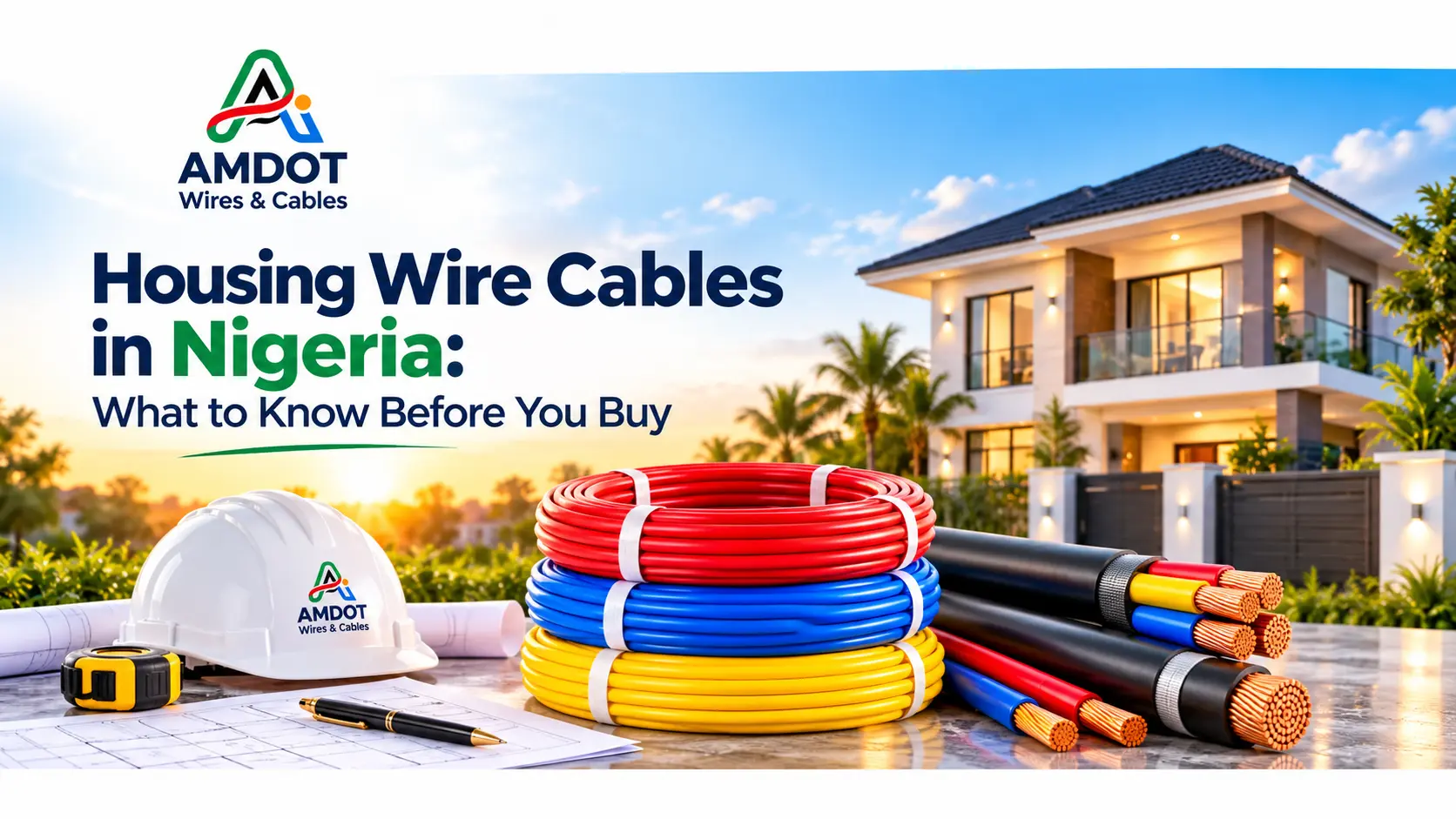
Our housing wires are single-core copper wires with FR/FRLS PVC insulation, available from 0.75 to 6.0 sq.mm.
Copper is used because it carries current well and copes with steady loads. FR means the insulation is flame retardant, so it resists catching fire. FRLS adds “low smoke”, which matters more than people realise. In a building fire, smoke is often what stops people from finding the exit, so insulation that gives off less of it buys valuable time.
Single-core wire is the usual choice for concealed and conduit wiring, where cables are pulled through pipes inside walls and ceilings. You will find it in lighting and power circuits, sockets, appliance connections and distribution boards, in homes, offices and shops.
One practical note. Thinner wire suits lighting, while thicker wire is needed for sockets and heavy appliances like air conditioners. Ask your electrician to size the wire to the load, and then make sure the wire you buy is good enough to deliver that rating.
When aluminium makes sense
Copper is not always the answer. On big jobs such as estates, industrial sites and long distribution runs, aluminium is a sensible choice. It is far lighter than copper, so it is easier to transport and handle, and it can bring the cost down when you need long lengths.
If you are searching for an aluminium cable supplier in Nigeria, look for someone who will talk through your project rather than just quote a price. At AMDOT, we are happy to help you work out whether aluminium or copper suits the job better.
Solar DC cables need to be tougher
More Nigerians are turning to solar every year, and it is easy to see why. The sun is free and generator fuel is not. But people often spend a lot on panels and inverters and then connect them with the wrong cable.
Solar DC cables in Nigeria live outdoors. They face strong sun, heat, dust and heavy rain for years. Ordinary indoor wire is not built for that, and it can wear out early or waste power along the way. Proper solar DC cable is designed for continuous direct current and outdoor exposure, so your system keeps performing and stays safe. Whether it is a small rooftop setup or something larger for a farm or business, the cable deserves as much thought as the panels.
A few things to check before you order
- Work out your load first, so you know which wire sizes you need.
- Check the insulation. For concealed wiring, flame retardant is not optional.
- Think long term. Rewiring a finished building is expensive and messy.
- Ask about delivery dates, especially for large orders. A delayed delivery can hold up a whole site.
- Use a certified electrician for the installation. Good cable still needs good workmanship.
Talking to us
AMDOT supplies housing wires, submersible pump cables, solar DC cables and aluminium cables for residential, commercial, industrial and solar projects. Our promise is simple: assured material delivery on time.